The Same Beings, Across Five Thousand Years
Sixty-two children in Zimbabwe, 2,561 DMT users, and medieval fairy lore describe the same kind of encounter. Nobody has a working explanation.

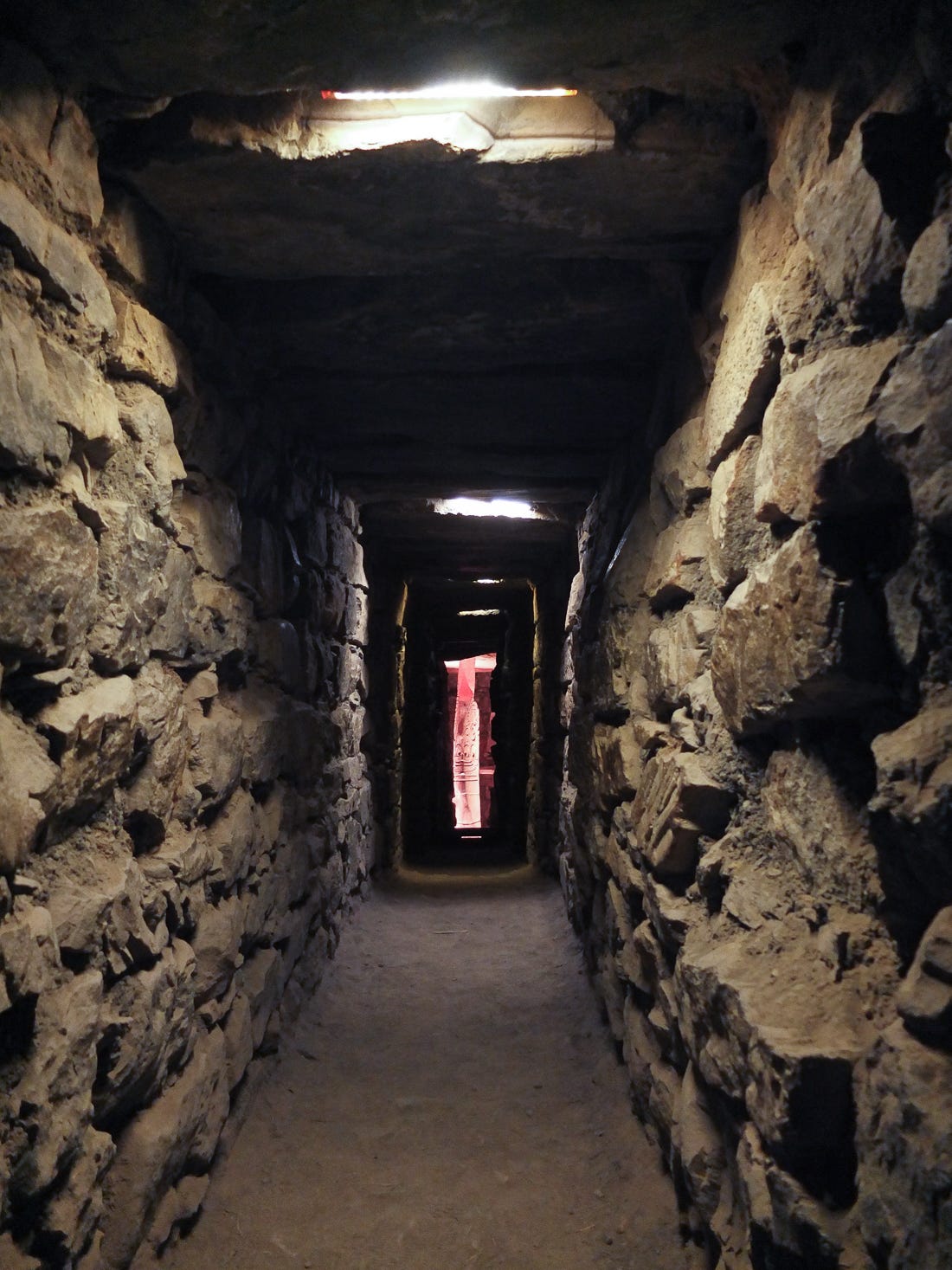
The Lanzón, the carved granite entity at the heart of the underground gallery at Chavín de Huántar, Peru. The figure was sited so that initiates would encounter it in total darkness, after acoustic disorientation and the consumption of psychoactive snuff. Photo: Manuel Machuca Saavedra, via Wikimedia Commons (CC BY-SA 4.0).
On September 16, 1994, sixty-two children at the Ariel School near Ruwa, Zimbabwe, went outside for morning recess and saw something land at the edge of the playing field. The children were aged six to twelve. Several reported a small figure in a tight dark garment emerging from or appearing near a silver object. The figure had large dark eyes. According to the children, it communicated not by speech but by a direct impression of images and feelings, including what they described as a warning about damage to the natural world.
Within days the children were interviewed by Cynthia Hind, a local researcher, and by Tim Leach of the BBC. Shortly afterwards John Mack, a Pulitzer Prize-winning psychiatrist at Harvard, flew to Zimbabwe and recorded sessions with them individually and in groups. The interviews are on film. The accounts varied in peripheral detail and agreed on the structural elements: the object, the being, the eyes, the wordless communication, the warning. Decades later, when the children had become adults with careers and families and no incentive to maintain a lie, the accounts had not changed.
This case is awkward for everyone. It is awkward for sceptics because there is no good story for how sixty-two primary school children, in a country where the American UFO narrative had almost no cultural presence in 1994, produced testimony with the same structural core that has held up under thirty years of follow-up. It is awkward for true believers because the children did not see a spacecraft from another star system. They saw something. They reported what they saw. The interpretation is the part where the trouble starts.
Now consider a different dataset.
In 2020, researchers at the Johns Hopkins Center for Psychedelic and Consciousness Research published a survey in the Journal of Psychopharmacology. The sample was 2,561 individuals who reported entity encounters during inhaled N,N-dimethyltryptamine experiences. DMT is the active compound in ayahuasca and is also produced in small quantities in the human body. When inhaled at sufficient dose, it reliably produces, in a large fraction of users, the perception of meeting autonomous beings.
The Davis et al. survey is online self-report, not a clinical trial, and the authors are explicit about that limitation. What it offers is a very large sample reporting on the same kind of experience. The numbers are striking. Ninety-six percent of respondents described the entities they met as conscious. Ninety-six percent described them as intelligent. Seventy-eight percent described them as benevolent. Seventy percent described them as sacred. Eighty percent said the encounter had altered their fundamental beliefs about reality. More than half of those who had identified as atheists before the experience no longer did.
These are not numbers you would expect from random neural noise. Whatever the brain is doing under DMT, it is doing it in a structurally similar way across thousands of people who took the substance alone, in different countries, with different cultural backgrounds, and reported back on the same kind of meeting.
A 2021 study in Frontiers in Psychology by Michael, Luke, and Robinson interviewed thirty-six DMT users immediately after their experiences. Ninety-four percent of reports involved encounters with other “beings.” One hundred percent involved emerging into other “worlds.” The 2023 follow-up paper analysed the same dataset from the perspective of the experiencer’s own self, and found the same pattern of overwhelming, ontologically disruptive contact with something that did not feel like a hallucination.
The structural features keep recurring across these studies. The entities are usually described as small, quick, and highly intelligent. They are often working with or displaying complex geometric objects. They display what experiencers describe as a kind of bemused familiarity, as if they have been expecting the visitor and the visitor is the one being studied, not the other way around.
This is exactly what Terence McKenna called his machine elves. It is also, with the proper noun changed, what the Amazonian ayahuasquero calls the plant spirits, what the Shipibo healer calls the medicine people, and what the Mazatec curandera calls the little ones who teach. Different cultures, different botanical sources, different traditions of preparation. Same kind of meeting.
Now go back four hundred years.
In 1969 Jacques Vallée, an astronomer and computer scientist who had spent the previous decade trying to bring scientific rigour to the UFO problem, published a short book called Passport to Magonia. The argument was simple. He laid the modern abduction reports next to the medieval European fairy tradition and asked the reader to look at the structure rather than the content.
In the medieval accounts, a person is taken at night by small beings of uncertain ontology. They are conveyed to a place that is described as another country but seems to operate by different physical rules. Time runs at a different rate there. They are subjected to some kind of ordeal, or shown some kind of marvel, or given some kind of instruction. They return changed. Sometimes they are physically marked. They cannot persuade their neighbours of what happened to them.
Read that paragraph again, substitute “small grey beings” for “fairies” and “examination table” for “fairy mound”, and you have the structure of a twentieth-century abduction account. The surface decorations differ. The narrative skeleton does not. This was Vallée’s point. The phenomenon, whatever it is, has been talking to us for a long time, and it talks in the local dialect.
The obvious objection is that human beings are pattern-matching animals who recycle their own myths, and that the modern reports are a folk tradition reshuffled with science-fiction imagery. This is a serious objection and it deserves to be stated honestly. It explains some of the data. It does not explain all of it, because the modern reports include cases like Ariel School, where the witnesses were too young to have absorbed the cultural template, and because the DMT reports include populations who had never read McKenna or seen Close Encounters and who nevertheless came back with the same kind of meeting.
There is a respectable neuroscientific account of what might be happening. Under DMT and similar compounds, large parts of the brain’s normal filtering apparatus go quiet. The default mode network, the system that maintains the boundary between self and world, becomes much less active. In its absence, lower-level neural processes that are usually suppressed can dominate awareness. The brain’s agency-detection system, which evolved to find other minds in the environment, may fire in the absence of input. The result, on this account, is the perception of autonomous beings where there are none.
The account is plausible. It may be correct. But it makes a prediction that the data do not bear out. If the entities are generated by a misfiring social cognition system with no input, their content should be variable, idiosyncratic, and culturally conditioned, in the way that dreams are. What people actually report is the opposite: a stubborn structural consistency across cultures and decades and pharmacological pathways and, in the Ariel School case, with no pharmacology at all.
The question this raises is not whether the entities are “real” in some final ontological sense. The question is what kind of phenomenon produces the same kind of experience in human nervous systems across thousands of years, multiple continents, several entirely different routes of access, and witness populations ranging from Harvard psychiatrists’ interview subjects to primary school children in southern Africa.
Nobody has a working answer to that question. The materialist account explains some of the data, not all of it. The literal extraterrestrial account explains almost none of the data, since it has no story for the medieval cases or the endogenous DMT releases. The Jungian collective-unconscious account explains the consistency but predicts no physical traces, and there are physical traces, including the photographs of the trampled grass at Ariel and the children’s drawings made within hours.
What the data show is the consistency. What the data do not show is the explanation. This is uncomfortable, and it is also where the honest reading has to stop.
The Chavín priesthood, two and a half thousand years ago in the Peruvian Andes, built a temple that combined acoustic resonance, total darkness, vilca snuff (a tryptamine psychedelic in the same family as DMT), and a carved stone entity called the Lanzón waiting at the end of an underground labyrinth. Recent peer-reviewed chemical analysis confirmed the residues. Older fieldwork had already established the acoustics and the architecture. The initiate would have met the chemical entity and the stone entity at the same moment, in the dark, in a sustained acoustic field.
We do not know what the priests believed they were doing. We do know what they built. They built a reliable way of producing the kind of meeting that the children at Ariel School had without preparation, that the Davis survey respondents had in their own homes with a pipe, and that medieval European peasants had at twilight near old stones. The machine produces the meeting. The meeting has been happening, with or without the machine, for as long as we have records of it.
The data do not tell us what the entities are. They tell us we have been meeting them for a very long time.
This is one thread from a longer argument in my forthcoming book, The God Machine: How Ancient Architecture Hacked the Human Brain.
Sources
Davis, A.K., Clifton, J.M., Weaver, E.G., Hurwitz, E.S., Johnson, M.W., and Griffiths, R.R. (2020). Survey of entity encounter experiences occasioned by inhaled N,N-dimethyltryptamine: Phenomenology, interpretation, and enduring effects. Journal of Psychopharmacology, 34(9), 1008-1020. https://doi.org/10.1177/0269881120916143
Michael, P., Luke, D., and Robinson, O. (2021). An encounter with the Other: A thematic and content analysis of DMT experiences from a naturalistic field study. Frontiers in Psychology, 12, 720717. https://doi.org/10.3389/fpsyg.2021.720717
Michael, P., Luke, D., and Robinson, O. (2023). An encounter with the self: A thematic and content analysis of the DMT experience from a naturalistic field study. Frontiers in Psychology, 14, 1083356. https://doi.org/10.3389/fpsyg.2023.1083356
Strassman, R. (2001). DMT: The Spirit Molecule. Rochester, VT: Park Street Press.
Vallée, J. (1969). Passport to Magonia: From Folklore to Flying Saucers. Chicago: Henry Regnery.
Mack, J.E. (1994). Abduction: Human Encounters with Aliens. New York: Scribner’s.
Nickerson, R. (dir.) (2022). Ariel Phenomenon. Documentary film. Follow-up interviews with surviving Ariel School witnesses as adults.
Rick, J.W., Lema, V.S., Echeverría, J., et al. (2025). Pre-Hispanic ritual use of psychoactive plants at Chavín de Huántar, Peru. Proceedings of the National Academy of Sciences, 122(19), e2425125122. https://doi.org/10.1073/pnas.2425125122
A note on the evidence :
The Davis 2020 survey is online self-report from a self-selected sample of 2,561 DMT users; the authors are explicit about this limitation. It is not a clinical trial and does not establish the nature of the entities, only the structure of the reports. The Michael, Luke, and Robinson 2021 and 2023 papers are naturalistic field studies with a smaller sample (n=36). John Mack’s work with abduction experiencers remains contested within psychiatry; the Harvard Medical School ad hoc committee chaired by Arnold Relman, which reviewed his methods from 1994 to 1995, concluded that he had the right to investigate the topic and issued no formal censure, while criticising his methods as not sufficiently “rational and scholarly” and recommending he bring a more multidisciplinary approach to the work. Vallée’s Passport to Magonia is a comparative analysis, not a controlled study; its argument is that the structural parallels between folklore traditions and modern reports are too consistent to ignore, not that any single tradition has been empirically validated. The Rick et al. 2025 paper on Chavín is peer-reviewed and chemically confirms the presence of psychoactive tryptamines (bufotenine, from vilca) and nicotine in the sealed gallery’s snuff paraphernalia; the interpretive claim about the Lanzón coinciding with the entity encounter is the author’s, building on Rick’s earlier published work on Chavín architecture and authority.